a whole moment of happiness
The phrase "a whole moment of happiness" appears as the final, exultant line of Fyodor Dostoevsky's "White Nights," spoken by the Dreamer after he has read Nastenka's farewell letter and accepted the loss of her love. It crystallizes the story's central paradox: that a single, brief interval of genuine human contact can outweigh a lifetime of isolation and fantasy. The expression is not merely a sentimental tag but a philosophical claim about the value of lived experience over the insubstantial riches of the imagination, and it has become one of the most quoted and resonant lines in Russian literature.
Origin and Context
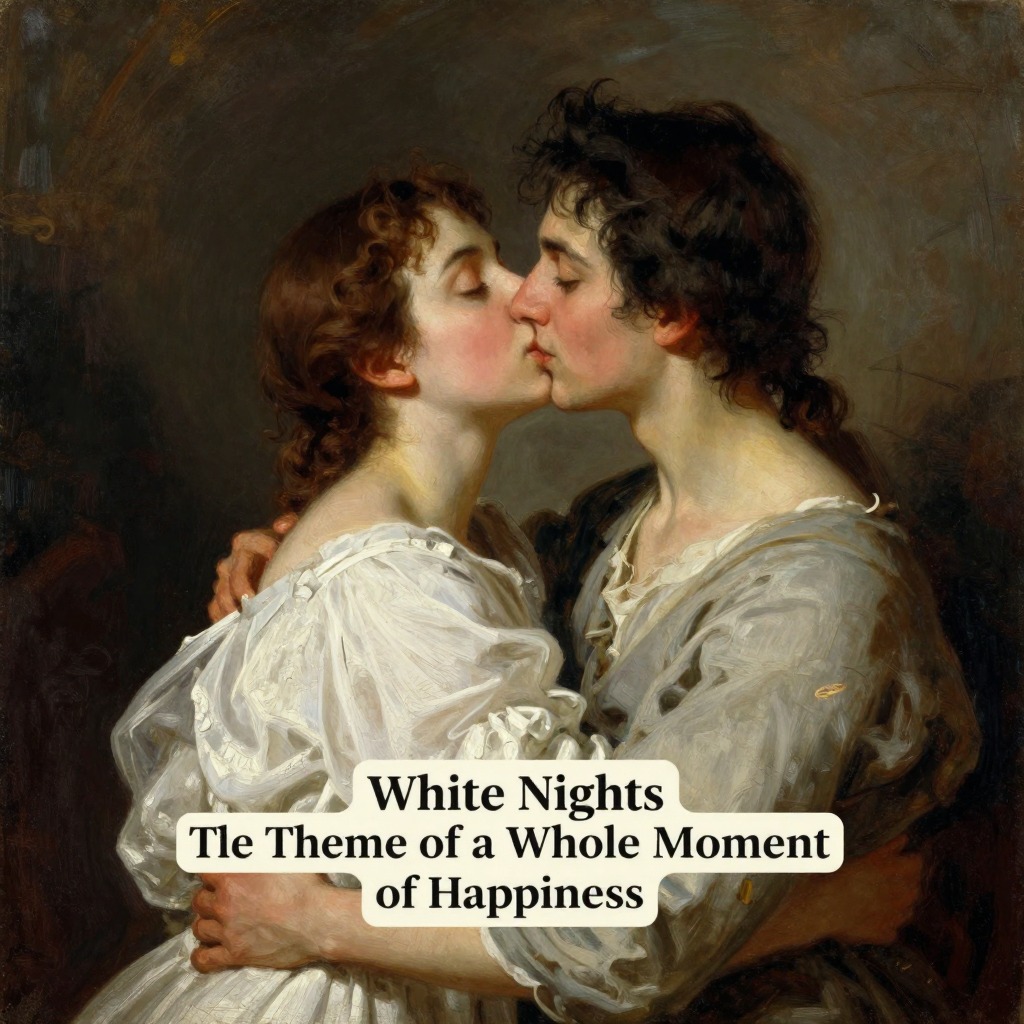
The line closes the narrative after the Dreamer has endured a night of feverish hope and crushing disappointment. On the Fourth Night, Nastenka, believing herself abandoned by the Lodger, turns to the Dreamer, accepts his love, and plans a future together. They walk in a state of delirious joy, discussing their shared life, until the Lodger suddenly appears. Nastenka rushes to him, kisses the Dreamer goodbye, and leaves. The next morning, the Dreamer receives her letter: she has reunited with the Lodger and will marry him in a week. She asks for the Dreamer's continued friendship. After reading the letter, the Dreamer, though heartbroken, refuses to resent her. He wishes her happiness and concludes: "My God, a whole moment of happiness! Is that too little for the whole of a man's life?" The question is rhetorical, and the implied answer is no—it is enough.
Thematic Significance
The phrase transforms the story's apparent tragedy into a kind of triumph. The Dreamer has spent his life as a "dreamer," a type he describes as an "intermediate creature" who lives in a world of fantasy, unable to engage with real life. He confesses to Nastenka that he has "lost all my best years" and that his existence feels like "a crime and a sin." Yet the four nights he spends with her—walking, talking, confiding, and finally loving—constitute a genuine, shared reality. Even though the relationship ends, the experience is not negated. The Dreamer explicitly rejects bitterness: he will not "cast a dark cloud over your serene, untroubled happiness" or "crush a single one of those tender blossoms." Instead, he elevates the memory of their connection into a permanent treasure. The phrase "a whole moment of happiness" thus redefines happiness not as a permanent state but as a qualitative intensity that can redeem an entire life, however brief its duration.
Narrative and Structural Role
The line serves as the story's final, summarizing beat, appearing after the Morning section's letter and the Dreamer's vision of his own future—fifteen years older, still alone, in the same room with the same Matrona. This bleak prospect makes the affirmation of the closing line all the more striking. The narrative structure of "White Nights" is built around a series of temporal frames: the four named nights, each with its own emotional arc, and the final Morning. The phrase "a whole moment of happiness" retroactively reinterprets the entire sequence. The Dreamer's earlier complaint that his life has been "nothing but dreams" is answered by the claim that a single real moment—the moment of mutual confession and the kiss—is more valuable than all his fantasies. The line also echoes an earlier moment in the story, when the Dreamer tells Nastenka that she has enabled him to say that "for two evenings, at least, I have lived." The final line extends that gratitude from two evenings to a single moment, compressing the valuation further and making it more absolute.
Legacy and Interpretation
The phrase has become a cultural touchstone, often quoted independently of the story as a celebration of ephemeral joy. In literary criticism, it is frequently cited as the key to the story's meaning, illustrating Dostoevsky's interest in the redemptive power of suffering and the value of authentic feeling. The Dreamer's refusal to curse his fate or envy Nastenka's happiness aligns with a Christian ethic of self-sacrifice and gratitude, but the line also carries a more modern, existential resonance: the individual creates meaning through a single, chosen act of affirmation. The phrase "a whole moment of happiness" is thus both a personal consolation and a universal statement about the sufficiency of love, however brief.